|
The following is a general description of the Ragdoll colours
and patterns but it is worth remembering that it is for guidance
only. Mitted and bi-colour Ragdolls homed as pets may be
‘mis-marked’ but this does not make them any the less lovable.
Ragdolls mature slowly and do not obtain their final coat colour
until they are approximately four years old, so the kitten which
joins its new family will look very different once it grows up.
Colourpointed Ragdoll
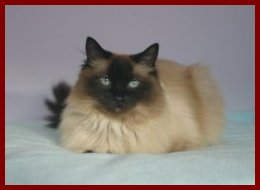 |
The points (mask, ears, tail and legs) are darker than
the rest of the body. The nose leather and pads match the
point colour and when the Ragdoll is mature, the mask covers
the entire face. |
Mitted Ragdoll
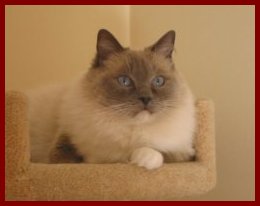 |
As with the colourpointed Ragdoll, the points are darker
than the main body colour. The nose leather is the
same colour as the points. The chin, bib, chest and
under body are all white. The front paws have white
mittens and the back hocks have white boots. The paw
pads are pink. Sometimes a mitted Ragdoll will have
a white nose blaze. |
Bi-coloured Ragdoll
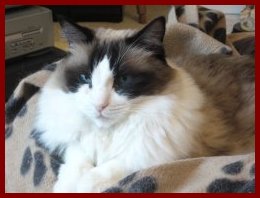 |
The bi-colour has an inverted white ‘v’ on the mask,
which extends from the forehead, between the eyes, down
to the chin, covering the nose and whisker pads. The
bib, chest, under body and legs are white. The nose
leather and paw pads are pink. The remaining points,
that is the rest of the mask, the ears and the tail, are
dark. |
Seal
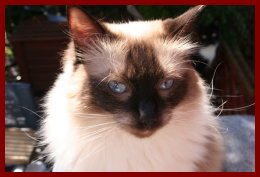 |
The points are a deep, dark seal brown, contrasting the
general body shading which ranges from a milky coffee to
a dark cocoa colour. |
Blue
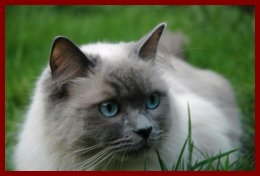 |
The points are slate blue/grey in colour, with the general
body colour shading to a silvery/ivory colour. |
Chocolate
The points are milk chocolate in colour and the main body shade
ranges from cream to ivory.
Lilac
The points are a frosted lilac/pink colour, with the body shading
to a warm magnolia hue. The eyes are generally paler blue.
Blue, seal, chocolate and lilac can overlay the colourpoint, mitted
and bi-colour patterns.
Red(Flame) Series and Tabby(Lynx) Ragdolls
There has been some controversy among some regarding these colours,
with suggestions they are not true Ragdolls. However this argument
is unfounded and it is known that Ann Baker worked with red and
tabby Ragdolls in her early breeding programme. Her belief was
that Ragdolls are defined by temperament and not by look and all
the colours and patterns she worked with were indeed Ragdolls
in every way. In June 2003 the GCCF gave the red and tabby Ragdolls
Championship status.
The Red and tabby series can overlay any of the three patterns,
colourpointed, mitted or bi-colour and bring to the breed stunning
looking Ragdolls.
Red
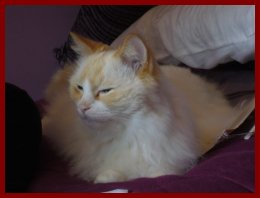 |
The body is pale cream in colour, with the tummy and
chest being lighter. The points range from flame orange
to red. |
Cream
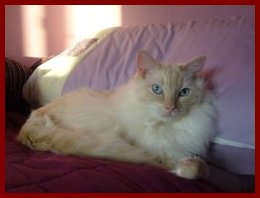 |
The body is off-white, with lighter colouring to the tummy
and chest. The points are cream.
|
Seal Tortie
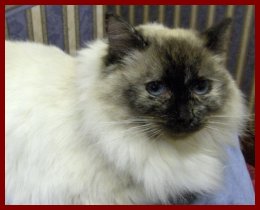 |
The body colour is shades of cream or beige, with lighter
colouring on the tummy and chest. The points are seal brown,
intermingled with patches of red. The points are seal, intermingled
with red shades.
|
Blue Tortie
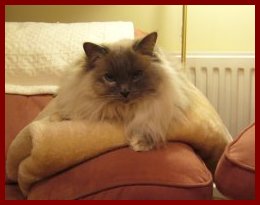 |
The body is blue-white or creamy, intermingled with with
shades of cream, with lighter colouring on the tummy and
chest. The points are blue, intermingled with cream.
|
Tabby
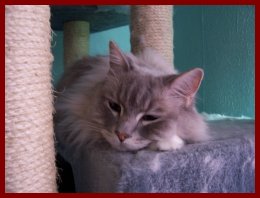 |
The tabby pattern can overlay any of the colours mentioned
above, including the reds, creams, and torties. Tabby Ragdolls
have distinct tabby markings of broken stripes and rings
on the points. The ears are solid without striping and there
is an 'M' marking on the forehead.
|
|
|